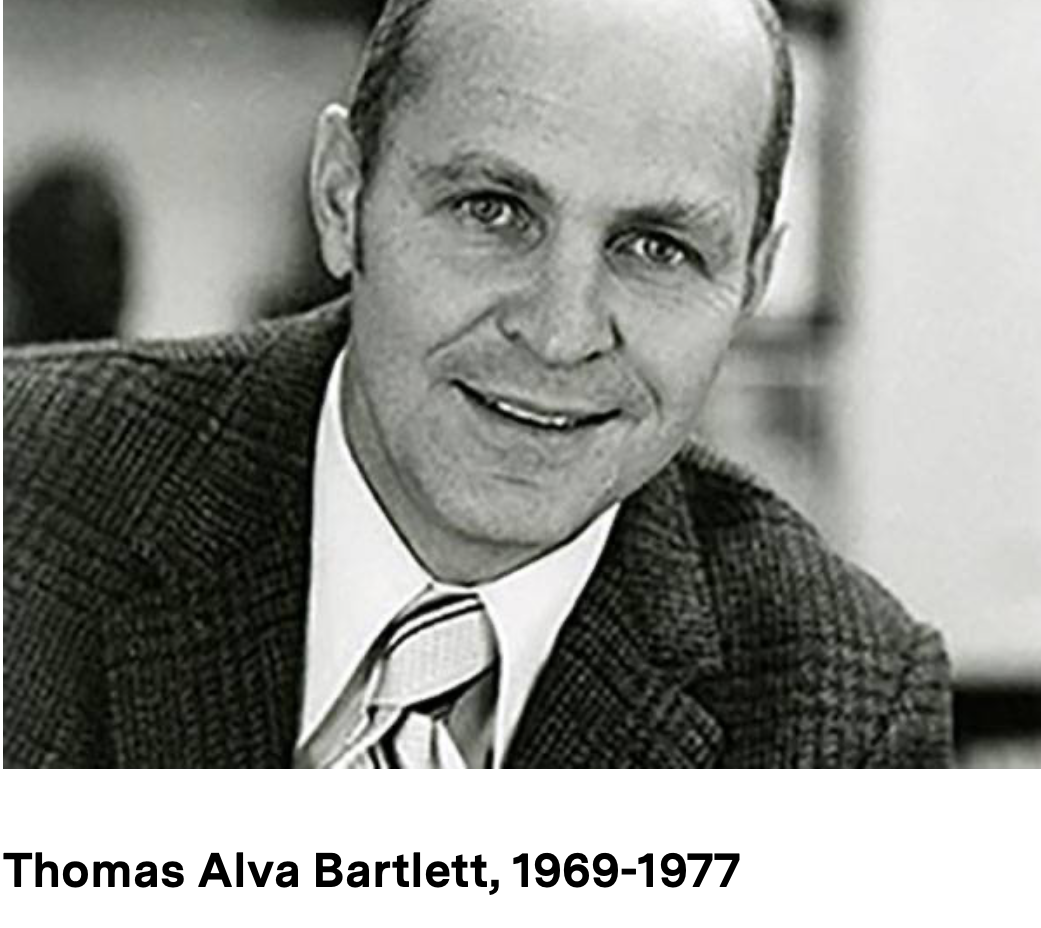
Lori’s WAYMAKER — Thomas Bartlett – Statesman, Global Leader, Rhodes Scholar and University President (1930 – )
Tom Bartlett grew up in Salem, Oregon, the son of a family of modest means, and went on to spend much of his life leading institutions at moments when the world around them was changing. He graduated from Stanford in 1951, went to Oxford as a Rhodes Scholar, earned his master’s degree there, and later completed his doctorate at Stanford. Bartlett once described Oxford as an escape from being “a poor man’s son from Oregon”; more importantly, he said being surrounded by people of extraordinary aspiration expanded his own sense of what was possible.
His career began international affairs. Bartlett worked in political and security affairs at the U.S. Mission to the United Nations, including work involving Arab-Israeli relations. Then, at just 33, he became president of the American University in Cairo. From 1963 to 1969, he led the university through one of the Middle East’s most turbulent periods while also helping build and expand the institution itself. He returned to the United States in 1969 as president of Colgate University, leading Colgate until 1977. Colgate later honored a career it describes as encompassing diplomacy, public service, university administration and leadership in higher education by establishing the Thomas A. Bartlett Chair.
In 1977, he became the first president of the Association of American Universities, representing America’s major research universities at the intersection of education, research and national policy. In 1982, he became Chancellor of the University of Alabama System. Then, in 1989, Tom came home to Oregon to become Chancellor of the Oregon State System of Higher Education. Returning home was part of what drew him back. This is where my life crossed his. I worked for Tom, and my desk sat directly outside the Chancellor’s office. We spent a great deal of time together and he always made room for me in his world. I wrote a song above about the first day of the Iraq War when he cleared his whole schedule for four hours just to talk to me privately about war and life and the future of my life. I hope you will listen to the song.
I was young, sitting only a few feet from a man who had worked at the United Nations, led universities on two continents, represented America’s great research universities and run an entire university system. Yet what I remember most clearly about Tom wasn’t his fascination with big things. It was his ability to see the significance of small ones. He could hold an enormous institution in his head and still notice the person, detail or seemingly insignificant clue that other people passed over.
Oregon wasn’t the end of Tom’s journey. In 1994, he became Chancellor of the State University of New York, adding one of America’s largest public university systems to an extraordinary lifetime of leadership. Later, he returned to the American University in Cairo as interim president, bringing his career back to an institution he had first led nearly forty years earlier.
At nineteen, I wasn’t reading about international relations in a classroom—I was sitting just outside Tom Bartlett’s office while some of the people shaping those relationships came through the door. Tom’s work on international education and global competence, and later his leadership of the United States-Japan Foundation, brought together educators, diplomats, policymakers and leaders from two countries whose relationship carried enormous economic and strategic importance. I helped Tom when those leaders came to Oregon, which meant that at nineteen I was suddenly inside the conversation: listening to how they spoke to one another, watching how relationships were built across cultures, seeing what happened before and after the formal meetings, and discovering that the great issues I had only known as headlines were actually being shaped by human beings sitting across a table from one another. Tom didn’t just introduce me to a larger world; for a brief moment, he gave me a seat inside its dialogue.
Tom mattered to me. His life demonstrated that scale and humanity do not have to be opposites. You can sit at the United Nations, lead great universities, manage systems encompassing thousands of people and still pay attention to the person sitting across from you. You can see the whole without losing the parts.
Picture Below Was When He Was President Of Colgate University